
No products in the cart.
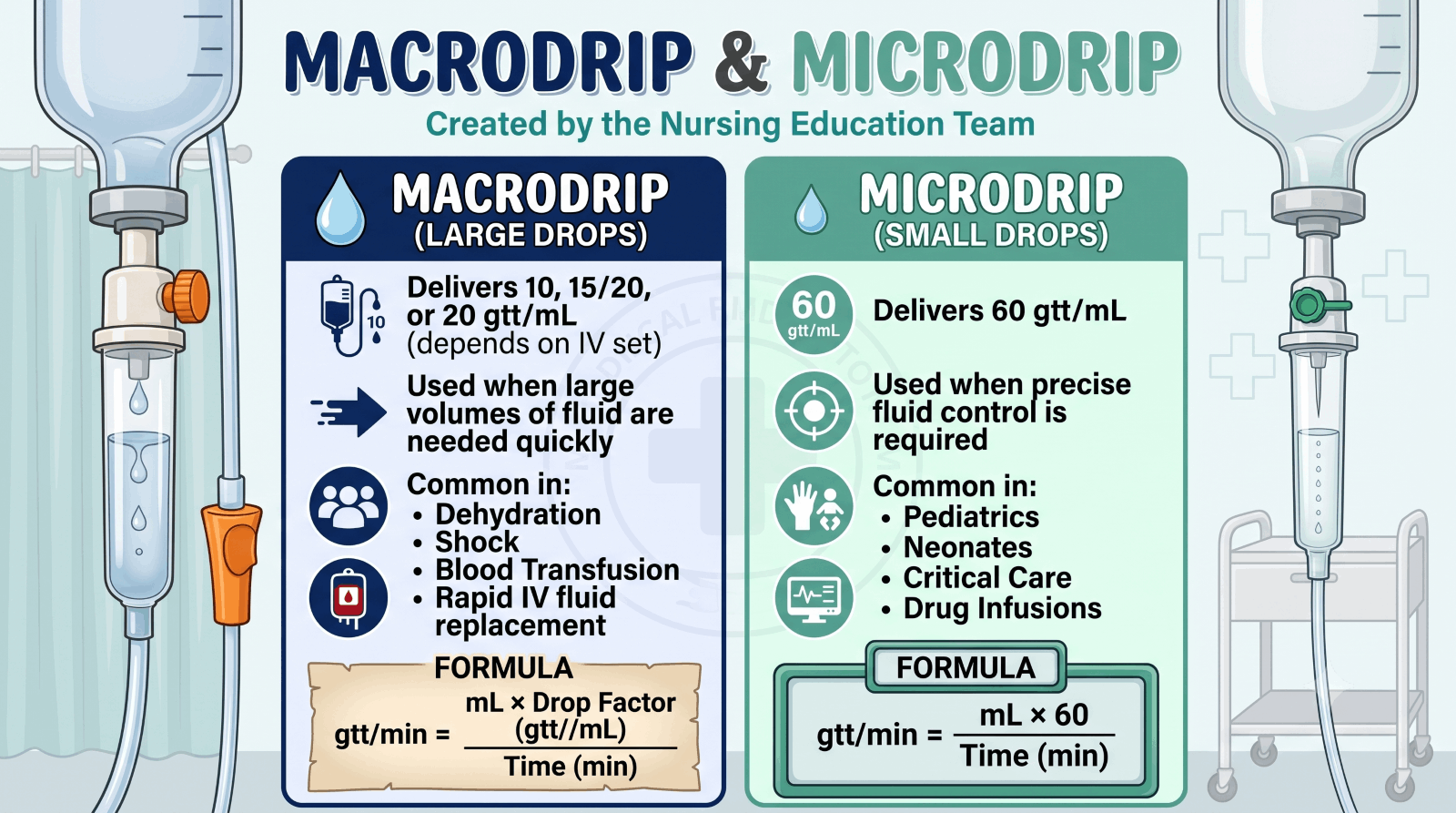
Macrodrip vs Microdrip IV Set: Difference & Drop Factor
Macrodrip vs Microdrip IV Set: Quick Difference
| Feature | Macrodrip IV Set | Microdrip IV Set |
|---|---|---|
| Drop size | Relatively larger drops | Smaller drops |
| Common drop factors | Often 10, 15 or 20 gtt/mL | Commonly 60 gtt/mL |
| Drops required for 1mL | Fewer | More |
| Gravity-flow adjustment | Larger volume represented by each drop | Smaller volume represented by each drop |
| Common clinical context | Often associated with larger volume gravity infusion | Often associated with situations requiring finer low-volume control |
| Is the drop factor universal? | No, do not assume—check the exact product | No, do not assume—check the exact product |
| Same as vented/non vented? | No | No |
| Same as a flow regulator? | No | No |
| Same as pump compatibility? | No | No |
Clinical references commonly describe macro sets as using approximately 10, 15 or 20 drops per mL, while micro sets are frequently supplied at 60 drops per mL. NCBI’s nursing resources also demonstrate that different drop factors exist and that the actual set value must be known when calculating a gravity infusion.
What Does Drop Factor Mean in an IV Set?
The drop factor, sometimes called the drip factor, tells you approximately how many drops produced by an administration set correspond to one millilitre of fluid.
It is normally expressed as:
gtt/mL = drops per millilitre
So: 20 gtt/mL means that the particular set is designed so approximately 20 drops represent 1 mL under the specified conditions.
60 gtt/mL means approximately 60 smaller drops represent 1 mL.
The drop factor comes from the drip-forming characteristics of the administration set. It is not something the user selects after opening the product.
For procurement teams, gtt/mL should therefore be treated like connector type, tubing specification or pack size: it must be identified for the exact SKU.
BD’s current infusion-set portfolio, for example, includes products supplied at 10, 15, 20 and 60 drops/mL. Baxter also currently lists administration sets specifically identified as approximately 60 drops/mL.
What Is a Macrodrip IV Set?
A macrodrip IV set produces relatively larger drops, meaning fewer drops are required to make one millilitre.
Common macro-type drop factors encountered in clinical references and manufacturer portfolios include:
- 10 gtt/mL
- 15 gtt/mL
- 20 gtt/mL
NCBI’s StatPearls dose-calculation reference describes most macro administration sets as using 10, 15 or 20 drops to make 1 mL. BD likewise lists infusion-set drop factors of 10, 15, 20 and 60 drops/mL across its portfolio.
A macrodrip label does not tell the buyer everything about the administration set.
Two 20 gtt/mL sets can still differ in:
- venting
- tubing material
- tubing length
- priming volume
- connector design
- number of access ports
- filtration
- flow-control components
- pump compatibility
- sterile presentation
That is why “macrodrip IV set” is not a complete purchase specification.
What Is a Microdrip IV Set?
A microdrip IV set produces much smaller drops.
A 60 gtt/mL configuration is widely encountered for microdrop administration sets. Open RN’s nursing reference lists a microdrop factor of 60 microdrops per millilitre, and Baxter currently markets sterile administration sets specified at approximately 60 drops/mL.
However, buyers should avoid turning this into an absolute rule that applies to every administration set worldwide.
One NCBI clinical reference notes micro sets with 45 or 60 drops/mL, while other current clinical and manufacturer references commonly use 60 gtt/mL.
That leads to a safer procurement principle:
Buy according to the stated gtt/mL specification, not according to the nickname alone.
10, 15, 20 and 60 gtt/mL: What Do These Numbers Mean?
A buyer may encounter several IV-set drop factors.
10 gtt/mL
Approximately 10 drops from the specified set represent 1 mL.
Because fewer, larger drops make up each millilitre, it is one of the lower drop-factor configurations found in administration-set portfolios. BD currently lists 10-drop configurations among its available sets.
15 gtt/mL
Approximately 15 drops represent 1 mL.
This is another macro-type configuration found in clinical references.
20 gtt/mL
Approximately 20 drops represent 1 mL.
Twenty-drop sets are common in current manufacturer portfolios. ICU Medical, for example, lists multiple administration-set configurations with a 20 drops/mL drip chamber.
60 gtt/mL
Approximately 60 small drops represent 1 mL.
This is the drop factor most commonly associated with microdrop administration sets in many current nursing references and manufacturer catalogues. Baxter currently lists sterile non-vented administration sets at approximately 60 drops/mL.
Is a 20 Drops/mL IV Set a Macrodrip Set?
A 20 gtt/mL administration set is commonly treated as a macrodrip configuration. But a hospital purchase order should still state:
20 gtt/mL
rather than writing only:
macrodrip
The numeric specification removes ambiguity.
This becomes especially important when suppliers stock several administration sets with different drop factors.
Is a 60 Drops/mL IV Set a Microdrip Set?
A 60 gtt/mL set is commonly described as a microdrip or microdrop administration set.
Current nursing references and commercial administration-set portfolios support 60 gtt/mL as a widely used microdrop configuration.
For procurement, however, the package and manufacturer’s specification remain the final product-level reference.
Do not identify a set as 60 gtt/mL merely because it has been stored in a box marked “micro”.
Why Drop Factor Matters
Drop factor is important because gravity infusion is observed in drops per unit of time, while prescribed fluid volume is normally expressed in millilitres.
Clinical references use the stated drop factor when converting a prescribed gravity infusion into drops per minute. One standard relationship is:
Drops/minute = Volume in mL × Drop factor in gtt/mL ÷ Time in minutes
This formula is provided here to explain why procurement accuracy matters—not as a substitute for a prescription, clinical calculation protocol or professional training.
If a hospital expects one drop factor but receives another, the relationship between drops counted and volume delivered changes.
That is why a purchasing error can become more than an inventory inconvenience.
Why 60 gtt/mL Has a Useful Mathematical Relationship
With a 60 gtt/mL set, there is a simple mathematical relationship between an hourly volume and the corresponding drop count:
Because there are 60 minutes in an hour and 60 drops per millilitre,
the numerical value of gtt/min equals the numerical value of mL/hour when the set is exactly 60gtt/mL.
This relationship follows directly from the standard gravity-flow calculation.
It should not, however, be used as a reason to change an infusion rate without an authorised prescription or clinical protocol.
The administration set does not determine the patient’s prescribed therapy.
Does Microdrip Mean “More Accurate”?
A microdrip configuration produces more, smaller drops per millilitre, which can provide finer manual increments when observing gravity flow.
That does not mean a microdrip set should automatically be described as more accurate than every other infusion system.
The overall delivery of an IV infusion can depend on the complete administration system, clinical setup and monitoring method.
Most importantly:
- A 60 gtt/mL gravity set is not the same thing as an electronic infusion pump or volumetric infusion controller.
- Drop factor describes the drops produced by the administration set.
- It does not describe pump programming accuracy.
Macrodrip vs Microdrip Is Not the Same as Vented vs Non-Vented
These are two completely different IV-set specifications.
- Macrodrip vs microdrip describes the drop factor.
- Vented vs non-vented describes whether the administration-set design provides a container air-inlet feature. A product can therefore have both descriptions.
For example, an IV set could potentially be:
vented + 20 gtt/mL
or
non-vented + 60 gtt/mL
depending on the manufacturer and SKU.
Baxter’s current catalogue demonstrates this separation clearly by listing 60 drops/mL products with a specified non-vented spike, while other manufacturer portfolios separately identify venting and drop factor characteristics.
Related guide: Vented vs Non-Vented IV Set: Difference, Uses & Buying Guide
Drop Factor Is Not the Same as a Flow Regulator
A drop factor is a calibrated characteristic of the drip chamber.
A flow regulator, roller clamp or other flow-control component is used to regulate flow through the administration line according to the product design and clinical setup.
An IV set may therefore have:
- a 20 gtt/mL drip chamber and roller clamp
- a 60 gtt/mL drip chamber and roller clamp
- a graduated flow-control component
- another specialised configuration
These features should be specified separately when purchasing.
Microdrip Does Not Automatically Mean Smaller IV Tubing
Another common mistake is to assume that “micro” refers to the diameter of the entire IV tube. The key macrodrip-versus-microdrip distinction is the drop formation within the drip chamber. NCBI’s clinical description explains that a micro set uses a drip-forming component that creates smaller drops.
Therefore, buyers should not infer:
- overall tubing diameter
- maximum flow capability
- connector size
- tubing length
- filter size
- priming volume
from the word microdrip alone.
Macrodrip vs Microdrip for Adult and Paediatric Requirements
Macrodrip and microdrip terminology is often associated with different clinical contexts.
Macro administration sets are commonly discussed where relatively larger-volume gravity delivery is required.
Microdrop sets are commonly associated with situations where smaller-volume or finer manual control is required. NCBI’s dose-calculation reference describes macro sets with lower drop factors and micro sets with smaller drops and higher drop factors.
However, a purchasing department should not convert these general associations into a clinical rule such as
“Adult = macrodrip, child = microdrip.”
The appropriate administration set depends on the prescribed therapy, patient, hospital policy, infusion equipment and professional clinical judgement. Procurement staff should purchase the specification approved by the relevant clinical department.
How to Identify a Microdrip or Macrodrip IV Set
The safest method is to check the written product information. Look for:
- 10 gtt/mL
- 15 gtt/mL
- 20 gtt/mL
- 60 gtt/mL
or another explicitly stated drop factor.
The value may appear on the:
- individual sterile pack
- outer carton
- product specification
- manufacturer’s catalogue
- Instructions for Use
Do not identify the drop factor only from packaging colour, tubing appearance or the shape of an unopened product.
Manufacturers offer administration sets in multiple drop-factor configurations, making the written specification the more reliable purchasing reference.
Suggested Tender Specification for a Macrodrip or Microdrip IV Set
A procurement specification can be structured like this:
Sterile, single-use IV administration set for gravity infusion; drop factor [10/15/20/60 gtt/mL as clinically approved]; [vented/non-vented/dual configuration if required]; compatible connector; specified tubing material and length; required injection port/filter/flow-control features; individual sterile packaging; batch traceability; required remaining shelf life; applicable regulatory and standards documentation.
The clinical and biomedical teams should approve the final technical specification before a tender or bulk order is released. For India, the Medical Devices Rules state that medical devices should conform to applicable BIS standards; where no relevant standard is laid down under that provision, the rules refer to ISO, IEC or applicable pharmacopoeial standards, with further provision for validated manufacturer standards where the earlier categories are not specified. ISO 8536-4:2019 is the current international standard titled “Infusion equipment for medical use — Part 4: Infusion sets for single use, gravity feed.” ISO states that this edition was reviewed and confirmed in 2025 and remains current.
Wholesale Buying Checklist for Macrodrip and Microdrip IV Sets
Before issuing a bulk IV-set purchase order, confirm:
- Exact drop factor: 10, 15, 20, 60 or another specified gtt/mL
- Administration method: gravity set or equipment-specific set
- Venting: vented, non-vented or another approved configuration
- Infusion-container compatibility
- Connector type
- Tubing material
- Tubing length
- Priming volume, if relevant to the specification
- Injection ports or needle-free access points
- Filter requirement
- Flow-control mechanism
- Sterility
- Single-use status
- Individual-pack configuration
- Units per box and case
- Batch or lot traceability
- Expiry date and required remaining shelf life
- Applicable standards and regulatory documentation
- Required total quantity
- Delivery location and schedule
- Whether substitutions are permitted
FAQ
Q.1 – What is the difference between macrodrip and microdrip IV sets?
The main difference is the drop factor. Macrodrip sets commonly use lower drop factors such as 10, 15 or 20 gtt/mL, producing larger drops. Microdrip sets commonly use a higher drop factor such as 60 gtt/mL, producing smaller drops.
Q.2 – What does 20 gtt/mL mean?
It means that approximately 20 drops produced by the specified administration set correspond to 1 mL under the relevant product conditions. Twenty gtt/mL is a commonly available administration-set configuration.
Q.3 What does 60 gtt/mL mean?
It means that approximately 60 smaller drops correspond to 1 mL. A 60 gtt/mL configuration is commonly associated with microdrop administration sets.
Q.4 – Is every macrodrip IV set 20 drops/mL?
No. current clinical references and manufacturer portfolios include macro-type configurations such as 10, 15 and 20 gtt/mL. Always check the exact set.
Q.5 – Is every microdrip IV set 60 drops/mL?
Sixty gtt/mL is a very common microdrop configuration, but buyers should not assume that every product in every market has exactly the same factor. One NCBI clinical reference discusses micro sets of 45 or 60 drops/mL. The exact manufacturer’s specification should therefore take priority.
Q.6 – Is microdrip better than macrodrip?
Neither is universally better. They have different drop characteristics and are selected according to the clinical requirement and administration system. Procurement teams should buy the drop factor approved by the healthcare facility rather than choosing one because it appears more precise.
Q.7. – Is microdrip the same as a paediatric IV set?
Microdrop administration sets are often associated with lower-volume and paediatric applications, but the terms should not be treated as universally interchangeable. Paediatric infusion requirements can also involve burette sets, infusion pumps or other specialised equipment depending on the clinical situation.
Q.8. Is macrodrip the same as a vented IV set?
No. Macrodrip refers to drop factor. Vented refers to an air-inlet feature associated with container compatibility. They are separate specifications.
Q.9. Is a 60 gtt/mL IV set always non-vented?
No. Drop factor and venting are separate characteristics. Manufacturers can offer different combinations, so both specifications should be checked independently.
Q.10 Is drop factor the same as flow rate?
No. Drop factor is a fixed characteristic of the administration set expressed in gtt/mL. Flow rate describes how quickly fluid is being administered. The drop factor is one of the values clinicians may use when determining the required drops per minute for a prescribed gravity infusion.
Q.11 How do I know whether my IV set is 20 or 60 drops/mL?
Check the individual package, manufacturer specification, outer carton and Instructions for Use. Do not guess the value from the appearance of the tubing or drip chamber alone.
Q.12 What should hospitals mention when ordering microdrip or macrodrip IV sets?
Specify the exact gtt/mL, venting requirement, connector, tubing requirements, filters or ports, equipment compatibility, sterility, packaging, shelf life, applicable documentation, quantity and delivery requirement.
Q.13 Where can healthcare buyers enquire for IV sets in bulk?
Medomet currently supports wholesale IV and infusion-product requirements for hospitals, clinics, pharmacies, medical stores, institutions and healthcare distributors across India.
For a drop-factor-specific order, include the required gtt/mL and complete technical requirement with the enquiry so the appropriate available product can be confirmed. You can buy a transparent infusion set IV for hospital use here.