
No products in the cart.
Buy Oxygen Delivery Devices Online in India
Buy oxygen delivery devices online in India from Medomet for hospitals, clinics, intensive care units, emergency departments, operation theatres, ambulances, nursing homes, respiratory care centres, medical stores, healthcare distributors, and medically supervised home-care requirements.
Explore oxygen masks, nasal cannulas, nasal prongs, oxygen tubing, Venturi masks, non-rebreather masks, tracheostomy masks, T-pieces, and related respiratory-care accessories. The available sizes, materials, connector types, tubing lengths, patient categories, and pack quantities may differ between products.
Oxygen delivery devices connect a prescribed oxygen source to the patient. The appropriate device depends on the patient’s condition, required oxygen concentration, breathing pattern, age, clinical setting, and the capabilities of the selected product. WHO guidance states that device selection should be based on clinical requirements and the device’s ability to deliver the required fraction of inspired oxygen, or FiO₂.
Oxygen is a prescribed medical treatment. Devices should be selected, assembled, and used only by trained healthcare professionals or appropriately trained caregivers following qualified medical guidance.
What Are Oxygen Delivery Devices?
Oxygen delivery devices are medical products used to carry supplemental oxygen from a cylinder, concentrator, piped supply, flowmeter, blender, or another compatible source to the patient.
The term may refer to the patient interface, such as a nasal cannula or oxygen mask, or to supporting components such as:
- Oxygen tubing
- Flowmeters
WHO identifies nasal cannulas, nasal catheters, simple masks, partial-rebreathing masks, non-rebreathing masks, head boxes, and tents among the available non-invasive oxygen delivery methods.
The correct product must match the oxygen source, prescribed flow, required FiO₂, patient size, and intended clinical application.
Classification of Oxygen Delivery Devices
Oxygen delivery systems are commonly classified as low-flow systems or high-flow systems.
Low-Flow Oxygen Delivery Devices
A low-flow oxygen delivery system provides oxygen at a flow that may be lower than the patient’s total inspiratory demand. Room air mixes with the supplied oxygen, so the FiO₂ received by the patient can vary according to breathing pattern, respiratory rate, device fit, and flow setting.
Common low-flow devices include:
- Standard nasal cannulas
- Nasal prongs
- Nasal catheters
- Simple oxygen face masks
High-Flow Oxygen Delivery Devices
A high-flow system is designed to provide gas flow that meets or exceeds the patient’s inspiratory demand. Depending on the equipment and setup, it can provide a more consistent prescribed oxygen concentration.
Examples may include:
- Venturi or air-entrainment masks
- High-flow nasal cannula systems
- Tracheostomy collars connected to suitable high-flow equipment
- Face tents connected to appropriate aerosol systems
A high-flow nasal cannula is different from a standard nasal cannula. HFNC systems generally require dedicated flow-generation, warming, and humidification equipment rather than only standard oxygen tubing.
Different Types of Oxygen Delivery Devices
Nasal Cannula and Nasal Prongs
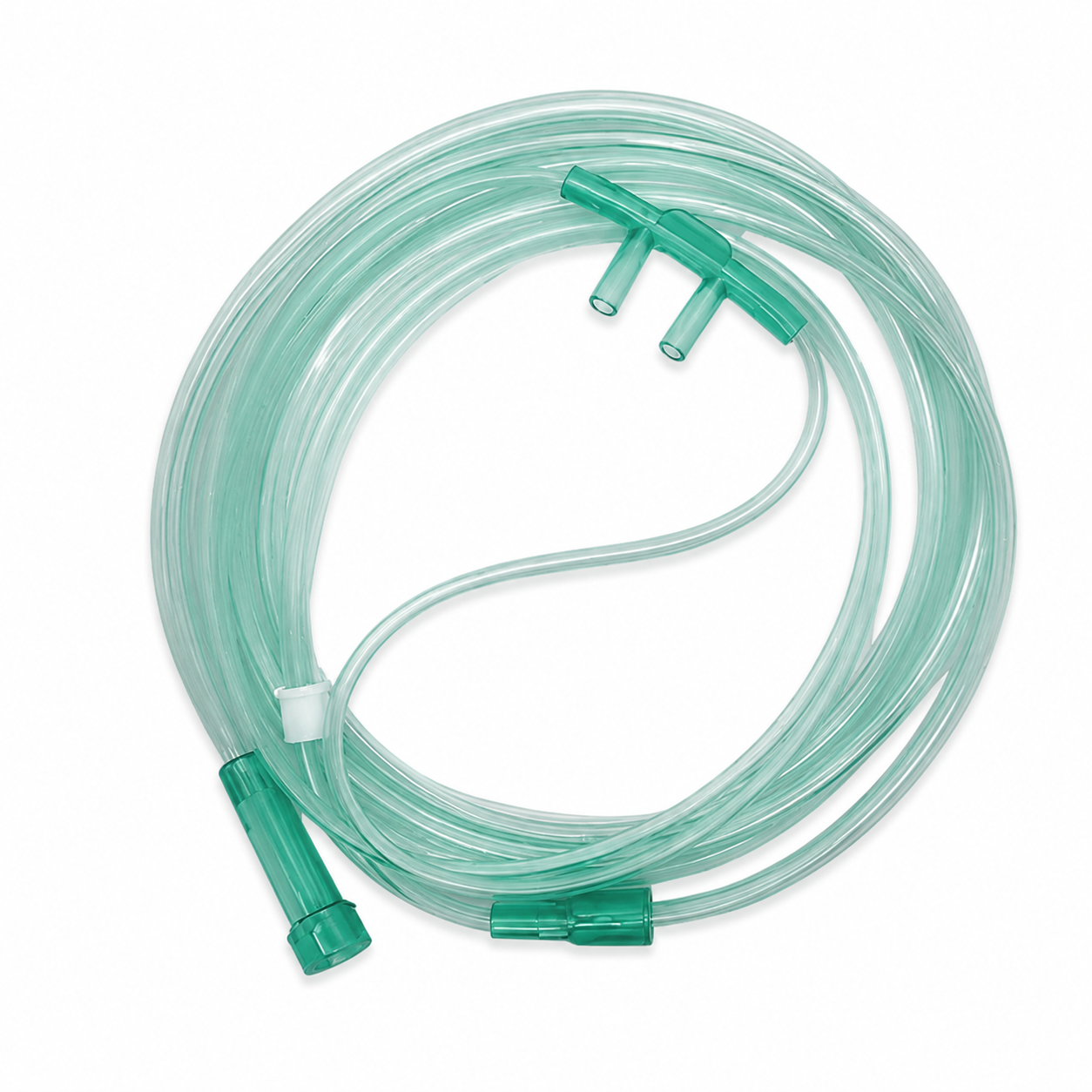
A nasal cannula is a lightweight oxygen delivery interface with two prongs positioned inside the nostrils. The tubing connects to a prescribed oxygen source.
Standard nasal cannulas are frequently used for low-flow oxygen delivery. They may allow the patient to speak, drink, and eat with less interference than many face masks. Actual oxygen concentration varies with the flow setting, prong fit, patient size, respiratory pattern, and mouth breathing.
Available options may include:
- Adult nasal cannulas
- Pediatric nasal cannulas
- Neonatal nasal prongs
- Straight or curved prong designs
- Different tubing lengths
- Soft-tip options
- Cannulas with over-ear tubing
- Products intended for single-patient use
Before ordering, check the patient category, prong dimensions, tube length, connector compatibility, packaging, and manufacturer instructions.
Simple Oxygen Face Mask
A simple oxygen face mask covers the patient’s nose and mouth and connects to an oxygen supply through compatible tubing.
It is sometimes described as a simple face mask or Hudson-type oxygen mask. The delivered FiO₂ can vary because room air enters through openings around the mask and because mask fit and breathing pattern affect performance.
Simple masks require an adequate minimum gas flow to reduce the risk of exhaled carbon dioxide accumulating inside the mask. The flow must be set by trained healthcare personnel according to the product instructions and clinical prescription.
Check:
- Adult, child, or neonatal sizing
- Mask material
- Adjustable strap
- Nose clip
- Tubing length
- Connector type
- Single-use instructions
- Sterile or non-sterile status
Venturi Mask Oxygen Delivery
A Venturi mask is an air-entrainment oxygen delivery system designed to provide a selected oxygen concentration when used with the correct adapter and prescribed flow.
Different colour-coded or adjustable diluters may correspond to different FiO₂ settings. For example, one Indian manufacturer lists settings ranging from 24% to 50%, but the available concentrations and required flow settings vary by product. Buyers must follow the instructions supplied with the specific mask rather than relying only on colour.
A Venturi mask may be considered when controlled oxygen delivery is clinically required. Proper performance depends on:
- Selecting the correct adapter
- Setting the stated minimum flow
- Keeping air-entrainment openings unobstructed
- Ensuring suitable mask fit
- Following manufacturer instructions
- Monitoring the patient
Non-Rebreather Mask Oxygen Delivery
A non-rebreather mask includes a face mask, reservoir bag, and one-way valve arrangement. It is designed to reduce the mixing of exhaled gas with oxygen from the reservoir.
The reservoir bag must remain adequately inflated during use. A collapsed reservoir may indicate insufficient flow, incorrect setup, obstruction, leakage, or a mismatch between the patient’s demand and the system.
Non-rebreather masks are intended for trained clinical use. They should not be applied without assessment, oxygen prescription, suitable monitoring, and correct equipment setup.
Before buying, check:
- Adult or pediatric size
- Reservoir-bag capacity
- Valve design
- Oxygen tubing
- Mask fit
Partial-Rebreather Mask
A partial-rebreather mask also includes a reservoir bag, but its valve configuration differs from that of a non-rebreather mask.
Some exhaled gas from the initial part of expiration may enter the reservoir. The oxygen flow should be sufficient to maintain the bag according to clinical and manufacturer instructions.
Because partial-rebreather and non-rebreather masks can look similar, buyers should confirm the exact product type before ordering.
Tracheostomy Mask and Trach Collar Oxygen Delivery
A tracheostomy mask, also called a trach collar, is positioned over a tracheostomy opening. It may be connected to a suitable oxygen and humidification system according to the patient’s clinical plan.
The setup may include:
- A tracheostomy mask or collar
- Corrugated tubing
- Humidification equipment
- Oxygen tubing
- A flow source
- An aerosol or air-entrainment system
The required flow and FiO₂ cannot be determined from the mask alone. They depend on the connected system, prescribed settings, humidification method, and patient requirements.
T-Piece Oxygen Delivery
A T-piece is an airway adapter that may connect to an endotracheal tube or tracheostomy tube. It can be used with a suitable humidified oxygen system in professionally supervised care.
A T-piece is not a complete oxygen delivery system by itself. It must be connected to compatible tubing, humidification equipment, and an appropriately configured gas source.
Check the connector size, circuit configuration, tubing compatibility, intended patient group, and manufacturer instructions before purchase.
Face Tent Oxygen Delivery
A face tent fits loosely beneath or around the patient’s chin and directs oxygen or humidified gas towards the mouth and nose.
It may be considered when a close-fitting mask is unsuitable, such as when facial access is required. However, the delivered oxygen concentration can vary because the interface is open.
Face tents should be used only with a suitable flow and aerosol system prescribed and monitored by healthcare professionals.
High-Flow Nasal Cannula Oxygen Delivery
A high-flow nasal cannula system provides warmed and humidified gas through dedicated nasal prongs. It differs substantially from a standard low-flow nasal cannula.
A complete HFNC setup may require:
- A compatible flow generator
- Oxygen and air supply
- An oxygen-air blender or integrated mixing system
- Heated humidifier
- Heated breathing circuit
- Patient-sized high-flow nasal cannula
- Monitoring equipment
High-flow settings are patient-specific. Pediatric guidance also stresses the use of correctly sized cannulas and professionally supervised flow selection.
Medomet should list HFNC machines, circuits, humidifiers, and cannulas as separate products if these items are available.
Bag-Valve-Mask Oxygen Delivery
A bag-valve mask, commonly known as a manual resuscitator, is a ventilation device rather than a standard passive oxygen mask.
A trained responder compresses the self-inflating bag to provide positive-pressure breaths. Depending on the model, it may connect to an oxygen source and reservoir.
Bag-valve-mask ventilation requires professional training. Incorrect mask seal, ventilation volume, rate, pressure, or airway positioning can cause serious complications.
List bag-valve masks under emergency and resuscitation equipment while linking them to this category when relevant.
Oxygen-Air Blender
An oxygen-air blender combines medical oxygen and medical air to create a selected oxygen concentration.
Blenders may be used with:
- High-flow nasal cannula systems
- Neonatal respiratory equipment
- Pediatric oxygen systems
- Ventilators
- CPAP systems
- Heated humidification systems
A blender must be compatible with the gas source, pressure range, hoses, flowmeter, circuit, and patient interface. Calibration, servicing, alarms, and preventive maintenance should follow the manufacturer’s specifications.
Oxygen Tubing and Connectors
Oxygen tubing connects the oxygen source or flowmeter to the patient interface.
Before buying an oxygen delivery tube, check:
- Tube length
- Internal diameter
- Connector style
- Kink resistance
- Source compatibility
- Patient-interface compatibility
- Material information
- Single-use instructions
- Packaging condition
Very long or kinked tubing may affect system performance. WHO procurement guidance recommends considering tubing distance, prescribed flow, patient size, oxygen concentration, safety, and device compatibility.
Difference Between High-Flow and Low-Flow Oxygen Delivery Systems
The difference is not based only on the number shown on the flowmeter.
Low-Flow System
A low-flow device generally supplies less total gas flow than the patient draws during inspiration. Room air enters and mixes with the supplied oxygen. This makes the received FiO₂ variable.
High-Flow System
A high-flow system is designed to provide enough total gas flow to meet or exceed the patient’s inspiratory demand. It may deliver a more predictable oxygen concentration when set up and used correctly.
A device may be described as high-flow because of the total gas delivered after air entrainment, not simply because a high oxygen flow is selected at the source.
Frequently Asked Questions
1. What is oxygen delivery?
Oxygen delivery is the process of providing supplemental oxygen from a medical oxygen source to a patient through a suitable device, such as a nasal cannula, oxygen mask, Venturi mask, or another prescribed interface.
2. What are the main types of oxygen delivery devices?
Common types include nasal cannulas, nasal prongs, simple face masks, partial-rebreather masks, non-rebreather masks, Venturi masks, tracheostomy masks, T-pieces, face tents, and high-flow nasal cannula systems.
3. What is the difference between high-flow and low-flow oxygen delivery?
Low-flow devices provide oxygen at a flow that may not meet the patient’s complete inspiratory demand, so room air mixes with the oxygen. High-flow systems are designed to meet or exceed inspiratory demand and can provide a more controlled gas mixture.
4. Which oxygen delivery system provides the most accurate FiO₂?
A Venturi or air-entrainment mask is commonly used when a controlled oxygen concentration is required. However, accuracy depends on using the correct adapter, prescribed flow, unobstructed air ports, suitable fit, and manufacturer instructions.
5. What is the maximum oxygen delivery through a standard nasal cannula?
Standard adult nasal cannulas are commonly referenced for flows up to 6 L/min, with variable FiO₂. This is different from a dedicated high-flow nasal cannula system. Never increase flow beyond the prescription or product instructions.
6. What is a Venturi mask used for?
A Venturi mask provides a selected oxygen concentration by mixing oxygen with entrained room air. It may be chosen when clinicians require controlled oxygen delivery.
7. What is a non-rebreather oxygen mask?
A non-rebreather mask is a reservoir-mask system with one-way valves intended to reduce the re-entry of exhaled gas. It requires adequate oxygen flow and professional monitoring to keep the reservoir appropriately inflated.
8. Which oxygen delivery device is used for COPD?
The device depends on the patient’s condition and prescribed target. A Venturi mask may be used when controlled oxygen is required, but only the treating healthcare team should select the device and setting.